
Free Combustion Emission Factor Finder
GHG Protocol–aligned calculation tool for stationary combustion emissions
Accurate emission factors are the foundation of reliable carbon accounting. Our free Combustion Emission Factor Finder is a structured, GHG Protocol–aligned tool designed to help organisations identify the correct emission factors for stationary combustion sources quickly.
Built for sustainability teams, ESG professionals, asset managers, and reporting specialists, this tool helps with the process of selecting emission factors for CO₂, CH₄, and N₂O, built on greenhouse gas (GHG) reporting standards.
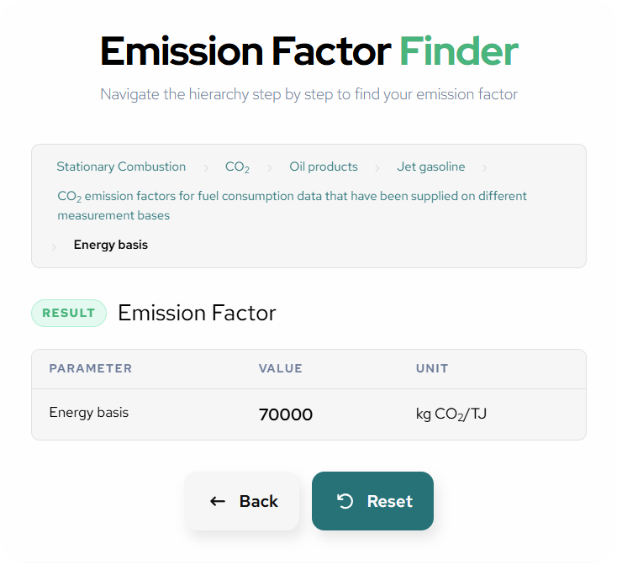
What the combustion emission factor finder does
The tool follows a structured decision pathway:
Activity type
Greenhouse gas
Fuel category
Specific fuel or waste stream
Step 1 – Select activity type
Stationary combustion (boilers, furnaces, turbines, generators, incineration, etc.)
Step 2 – Select greenhouse gas
- CO₂
- CH₄
- N₂O
Step 3 – Select fuel category
- Oil products
- Coal products
- Natural gas
- Biomass
- Other wastes
Step 4 – Select specific fuel or waste stream
Examples include:
- Municipal waste (non-biomass fraction)
- Industrial wastes
- Waste oils
The system then identifies the appropriate emission factor for calculation.
GHG Protocol alignment
The tool is aligned with methodologies from the GHG Protocol Corporate Standard and associated cross-sector calculation guidance. It supports:
Scope 1 direct emissions reporting
Stationary combustion accounting
Multi-gas reporting (CO₂, CH₄, N₂O)
Consistent data treatment across reporting frameworks
Consistent data treatment across reporting frameworks
Suitable for organisations reporting under:
GHG Protocol
CSRD / ESRS
SFDR
TCFD
IFRS S2
Voluntary disclosures
[emission_tool]
Frequently Asked Questions
What is a combustion emission factor?
A combustion emission factor converts fuel consumption into greenhouse gas emissions such as CO₂, CH₄, and N₂O, based on standardised methodologies.
Which emissions does this tool support?
The tool supports stationary combustion Scope 1 emissions for CO₂, CH₄, and N₂O.
Is this tool aligned with the GHG Protocol?
Yes. The methodology follows GHG Protocol cross-sector guidance for stationary combustion emissions.
Can this tool support regulatory reporting?
Yes. It supports emissions calculations required for CSRD, SFDR, ESRS, and other sustainability frameworks.
A combustion emission factor converts fuel consumption into greenhouse gas emissions such as CO₂, CH₄, and N₂O, based on standardised methodologies.
The tool supports stationary combustion Scope 1 emissions for CO₂, CH₄, and N₂O.
Yes. The methodology follows GHG Protocol cross-sector guidance for stationary combustion emissions.
Yes. It supports emissions calculations required for CSRD, SFDR, ESRS, and other sustainability frameworks.